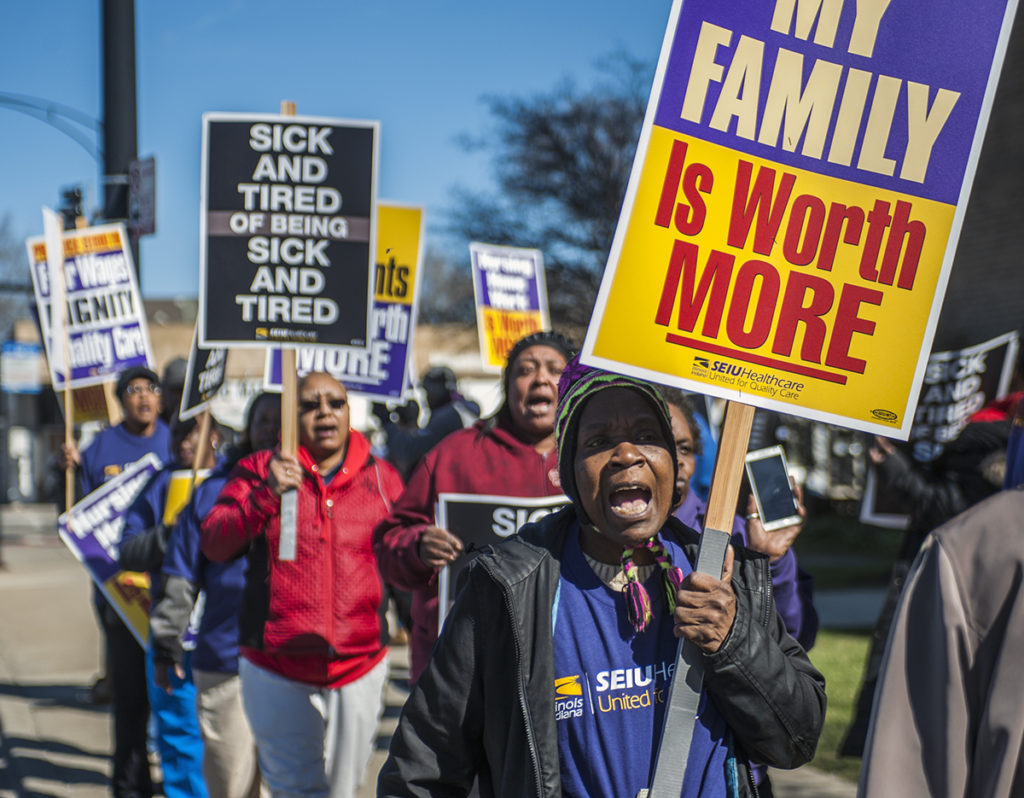
As the legislative session heats up and the city of Indianapolis prepares for this year’s Super Bowl, Indiana Republicans are fighting to punch through so-called “right-to-work” legislation that would limit collective bargaining for workers as fast as they can.
But Indiana Democrats and SEIU members are working just as hard to stop this anti-worker, pro-corporate legislation, and to educate the public about the harm right-to-work laws have caused in other states. Yesterday, members from all over the state traveled to the Capitol to fight against legislation that puts corporate greed ahead of Indiana families.
“We spent some time talking to state Democrats like Senator Vi Simpson and Rep. Peggy Welsh, thanking them for looking at things from the perspective of working people,” said home care worker Kelley Sims. “They thanked us for coming out to support them as they work to support us.”
“But we also talked to some Republican lawmakers who were either for right-to-work legislation or are on the fence about it. A lot of them said they support these bills because they might convince businesses to come to Indiana. I asked them, are we really making things better for Indiana if companies come here just because they know they can treat their workers however they want and pay them less than a fair wage?”
There is no solid evidence that right-to-work states attract businesses more than states without these laws: according to the Economic Policy Institute, “the evidence is overwhelming that right-to-work laws have not succeeded in boosting employment growth in the states that have adopted them.” However, studies conducted by the US Department of Labor, the US Census Bureau, and others have found that workers’ quality of life decreases with the passage of right-to-work laws. For example, Indiana workers currently earn a higher wage on average than workers in right-to-work states, and are more likely to have job-based health insurance and pensions.
As Indiana Democrats continue to fight to defeat this harmful legislation, our members will keep holding Republican lawmakers accountable to their constituents—not greedy corporations.
“We’ll stick together and keep fighting until we get our point across,” said Kelley.
Our members will head back to the Statehouse to keep working for the rights of working people on January 24th.
See home care worker Vicky Hernandez testify at the Statehouse:
Thousands of union members, workers, students, Occupiers, the unemployed, and more traveled from all over the country this week to unite in Washington DC. Waiting hours in legislators’ offices, sleeping in tents and on floors, and marching through heavy rainstorms, our members sent the message that the American middle class has had enough of corporate greed and recklessness.

Our members camped out in lawmakers' offices for hours, hoping to engage them about the issues that matter to working people.
“We’re here because the 99% is suffering,” said Reverend CJ Hawkins of Arise Chicago and Stand Up! Chicago. Our government has been bought up by lobbyists on K Street, and we’re addressing that by stopping business as usual. We’re taking back the capitol, we’re taking back the street, and we’re taking back our lives.”
“It was electrifying,” said home care worker Renea Williams, who marched all day to take over K Street, where DC’s most influential lobbyists are based. “You could see that everyone’s hearts are really in this—they’d have to be, to keep up the songs and chants despite the rain!”
In addition to shutting down K street and marching on the Capitol, members and allies camped out in legislators’ offices, hoping to talk to them about economic issues affecting the 99%. Some demonstrators succeeded in meeting with legislators, like Democratic Rep. Emmanuel Cleaver from Missouri, but others made themselves scarce when faced with the prospect of addressing the 99% face to face.
“We had an appointment to talk to Rep. Joe Walsh about protecting Medicare and Social Security and he slammed the door in our faces,” said home care worker Annette Jones. “We chased him all over the Capitol and he ignored us. These Republican legislators don’t seem to understand that the people who had the power to elect him also have the power to kick him out!”
See video of Reps. Joe Walsh, Adam Kinzinger, and Don Manzullo and Sen. Mark Kirk running from their constituents:
SEIU Healthcare Illinois and Indiana members spread a little Christmas cheer at the Chicago Board of Trade last week, conducting a Salvation Army-style mock charity drive for the CME Group.

"We see you when you're stealing, we need you to atone, we know when you make money, so you better leave us alone!"
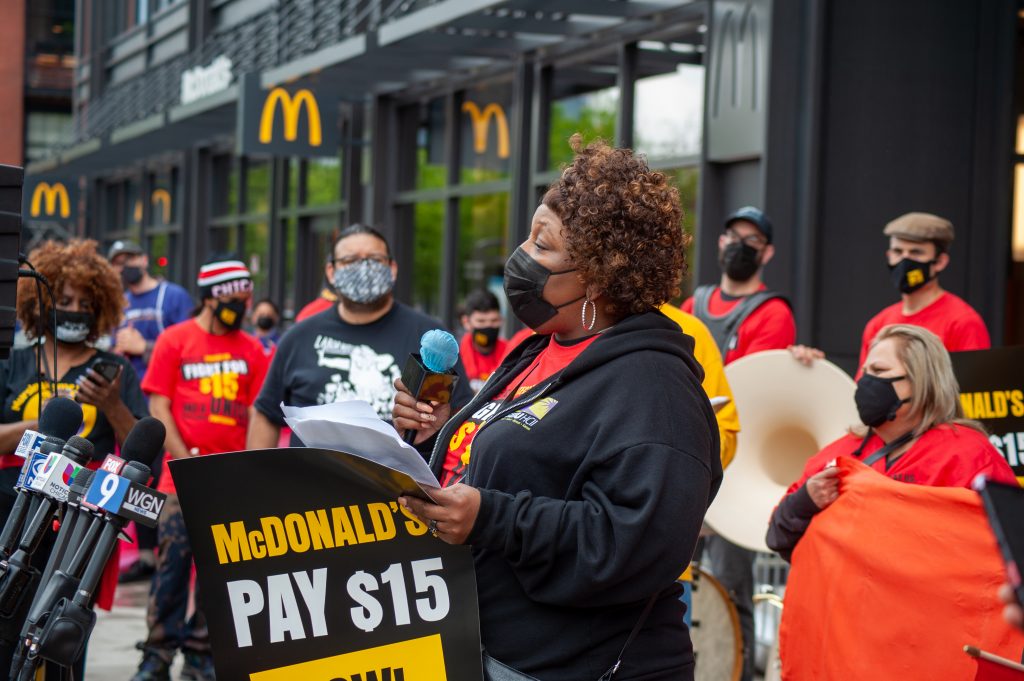
The CME Group has made headlines recently as its bid for a $100 million state tax break was overwhelmingly defeated by the Illinois House of Representatives, but the group’s demand for corporate welfare is likely to resurface in Springfield. Despite earning $900 million in profits last year, the CME Group has repeatedly threatened to leave the state, taking its jobs with it, if legislators don’t pander to its demands for a taxpayer handout.
In spite of members’ Santa hats, festive bells, and lovely singing voices belting adapted Christmas carols like “CME gets tax breaks, and we get charged more, they’re the Grinch that stole Christmas, stealing from the poor!” to the tune of “We Wish You a Merry Christmas,” few passersby seemed interested in giving to the rich this holiday season.

"Taking money from the many, stealing taxes penny by penny!"
“These people have their hands out to get even more money from taxpayers, money we should be spending on things that the poor and the middle class need, like job creation and Medicare. People are losing their homes, their jobs, they don’t have money for food, and the CME is threatening to take their jobs out of the state if we don’t give them $100 million? Everyone knows that’s a scare tactic. It’s blackmail,” said DORS PA Flora Johnson.
After the demonstration at the Board of Trade, members went across the street to the Occupy Chicago site at Jackson and LaSalle to deliver lunches to protesters there.
See video from the demonstration:
Members are putting our voices together to thank the Congressional Democrats who succeeded in protecting good jobs and quality health care from Republicans last week.
By calling 877-736-7831, we’re thanking the lawmakers who stood strong to support good jobs and quality health care for working families, seniors, people with disabilities and others–and encouraging them to hold their ground for us in the future.
“On behalf of more than 91,000 workers united in SEIU Healthcare Illinois and Indiana, we thank Democrats in Congress for protecting Medicaid and Medicare from crippling cuts that would have endangered the jobs, the health, and in some cases, the lives of people who depend on these critical safety net programs. By blocking these cuts, people with disabilities can continue to live independently, safety net hospitals can remain open for the communities they serve, and health care workers will keep their jobs, preventing further deterioration in our already embattled economy,” said SEIU Healthcare Illinois and Indiana President Keith Kelleher.
Now it’s our turn to thank the Democrats who stood up for us against Republicans who cater to the one percent rather than protecting jobs and healthcare for working families. These wealthy politicians aren’t done trying to cut the services we need, so we need to let our lawmakers know that we appreciate their support–and urge them to stay strong for us in the future.

Members and allies demonstrated on a bridge in Joliet, calling on Rep. Adam Kinzinger to put his constitutents to work.
All across the country on November 17th, unions, community groups, chapters of the Occupy movement, and other diverse representatives of the 99% came together to demand support for job creation instead of more corporate welfare.
In Chicago, Joliet, and St. Louis, SEIU Healthcare members spoke, marched, and occupied bridges to speak against cuts to vital safety-net programs as hundreds of similar actions across the country made our voices even stronger.
Home care worker Veronica Wansley spoke out for home care consumers on a bridge in St. Louis.
“My consumer has multiple sclerosis, and she’s blind. It’s a proven fact that it would cost more to put her in a nursing home than to continue to fund the programs that allow me to help her stay safe and independent in her own home, and it would eliminate the jobs of thousands of health care workers like me. I’m here to say that Congress needs to focus on protecting jobs and safety-net programs, not tax breaks for corporations and the rich,” Veronica said.
“I depend on Social Security, Medicaid, and public housing to get my needs met, but I’m not just worried about me,” said Jane Addams Senior Caucus leader Ruth Long, addressing the crowd in Chicago shortly before it shut down the LaSalle St. bridge. “I’m worried about the thousands of vulnerable Americans who depend on these programs who are suffering because of the greed and selfishness of the 1%.”
Hear more from Veronica, Ruth, and other participants at our three actions, and read more about the National Day of Action.
When Ohio Governor John Kasich followed in Wisconsin Governor Scott Walker’s footsteps by signing a bill (SB5) decimating the collective bargaining rights of public sector employees, SEIU Healthcare members jumped up to stop him.

Members knocked knocked on almost 7000 doors in a week to educate Ohio voters about SB5. Their efforts helped the bill to be repealed!
Unlike Wisconsin’s, Ohio’s constitution allows for a citizen’s veto, giving residents a chance to bring a bad bill to a ballot–if they can gather enough signatures.
With help from fifteen of our members, organizers gathered 1.3 million signatures, giving voters the opportunity to send the message that working people aren’t going to accept attacks on our bargaining rights.
“These Republican governors all over the country are trying to cut out the middle class. We want the whole country to see what’s going on and say, enough is enough,” said McKinley Williams, a groundskeeper at Methodist Hospital in Gary, IN who spent a week in Cleveland knocking on doors to educate residents about the devastating impact of SB5.
“I met a lot of people in the area whose lives would have been immediately affected by this bill–teachers, state workers, city workers, and more,” said Ella Giles, a home care worker in St. Louis. “But even most of the people who weren’t going to be affected right away were on our side, because people know that once they start chipping away at working people, it’s only a matter of time before they start chipping away at you.”
Excluding Election Day, Williams, Giles, and other members knocked on 6842 doors and had 2152 conversations with voters in just one week, getting support from more than 90% of them and leading 61% of Ohio voters to repeal the bad bill. As Gov. Walker’s recall heats up in Wisconsin, this victory not only protects good jobs for thousands of Ohio residents, but will have a real impact on our efforts to protect bargaining rights for working people all over the United States.
“The most recent polls show that the majority of people in Wisconsin want to recall Scott Walker,” McKinley said. “I’m fired up and ready to go to Wisconsin next!”
Health care workers, elected officials, patients, and allies joined the growing chorus of Americans speaking out to protect vital Medicare and Medicaid funding at a rally in Gary, Indiana earlier this week.
While Congress decides whether to invest in the health of working people by continuing to fund Medicare, Medicaid, and Social Security or to continue granting tax breaks to big banks and corporations, people like home care worker Vicky Hernandez are fighting hard to help Congress understand the devastating impact that funding cuts could have on some of our most vulnerable citizens.
“Medicaid pays for my consumer’s medication and for me to be there to help with things like showering, eating, and going to the bathroom–things that we all take for granted. Our lawmakers don’t have to think about losing these things. They don’t realize what these cuts mean,” Vicky said.

Home care worker Vicky Hernandez speaks out for her consumer, who relies on Medicaid to pay for the program that keeps her safe and independent living in her home.
In addition to the impact cuts would have on consumers, Vicky and other speakers at the rally addressed the impact cuts could have on our economy.
“If these cuts happen, patients will suffer. But so will thousands of health care workers who will lose their jobs. Cutting programs that keep people healthy and employed is no way to fix our economy,” said Tony Marshall, a CNA at Methodist Hospital in Gary, IN.
More and more of us are getting together to tell Congress that vital funding for Medicare, Medicaid, and child care programs is the last thing they should cut. Read more about our upcoming National Day of Action and find out how you can get involved.
Hear more from Tony and Vicky at the rally:
Workers, patients, and others whose lives would be negatively affected by the closure of Englewood’s St. Bernard Hospital gathered there on November 10th to say, “Hands off my Medicare!”
As Congress’ supercommittee works toward a decision about how to handle our nation’s debt crisis, working people all over the country are sending the message that cutting the funding that keeps vital safety-net hospitals running isn’t the way to fix our broken economy. In addition to leaving low-income and elderly community members high and dry when it comes to their health, hospital closures due to Medicaid and Medicare cutbacks will put thousands of health care providers out of work–61,000 in Illinois alone.

Englewood resident Frances Smith tells the crowd how the closure of St. Bernard Hospital would affect her health.
“People like Ms. Frances count on this hospital,” said St. Bernard Unit Secretary Veronica Powell, referring to a resident of a nearby retirement building who also spoke at the rally. “Cutting the funding that keeps St. Bernard open means cutting off their lifeline to the care they need.”
“And, cutting funding means cutting jobs from our economy,” Veronica added. “St. Bernard is the largest employer in Englewood–if this place closes, I’ll be out of a job, along with nearly 700 other workers.”
Hear more from Veronica and Frances Smith:
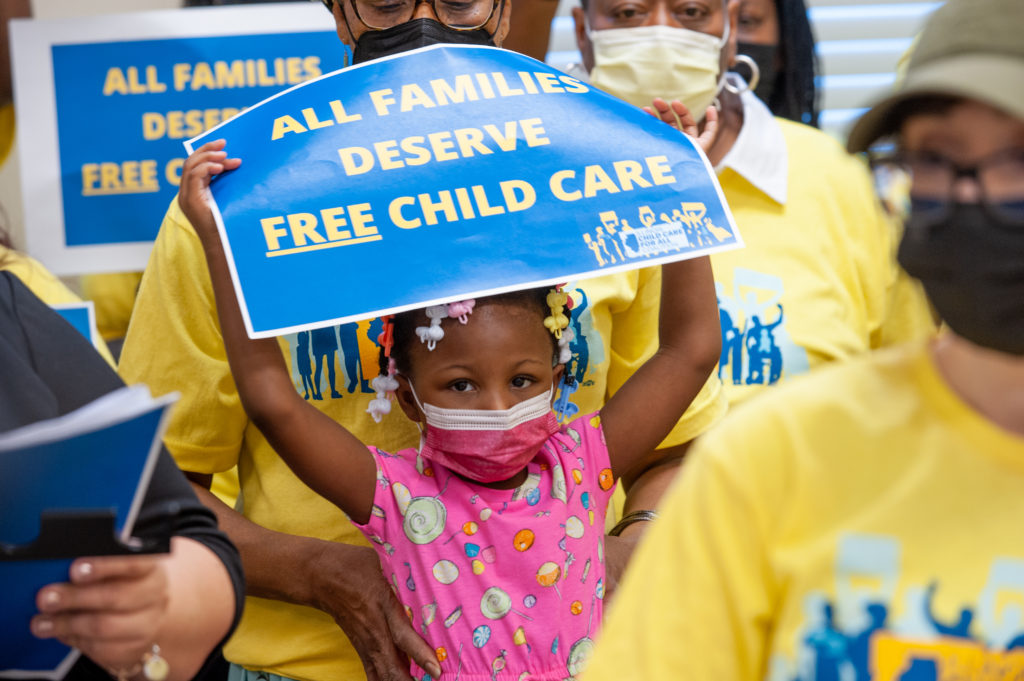
Right now, Congress’ supercommittee is deciding how to reduce our nation’s looming deficit, and with it, the fate of Head Start programs that provide working families with the quality care they need to stay in school and got to work every day. Together, child care providers and consumers are working to make millionaire members of Congress understand that cuts to federal funding of state child care programs will make it harder for parents to take or keep the jobs they need to support their families as the economy struggles to recover.
“I’m a single mother juggling school, work, and motherhood. I and thousands of other parents depend on programs like Head Start to provide not just a safe place for my son to stay while I’m at work, but to give him a good education. Federal child care funding makes it possible for many families to improve their lives by working while going back to school in order to make it in this economy–if it weren’t for Head Start, I couldn’t make this work for my family.” –Candice Battle
It’s up to us to carry the voices of working parents to the representatives making decisions that affect their lives. Please talk to your child care parents about the impact that quality child care makes on their lives and families, and share their answers with us.
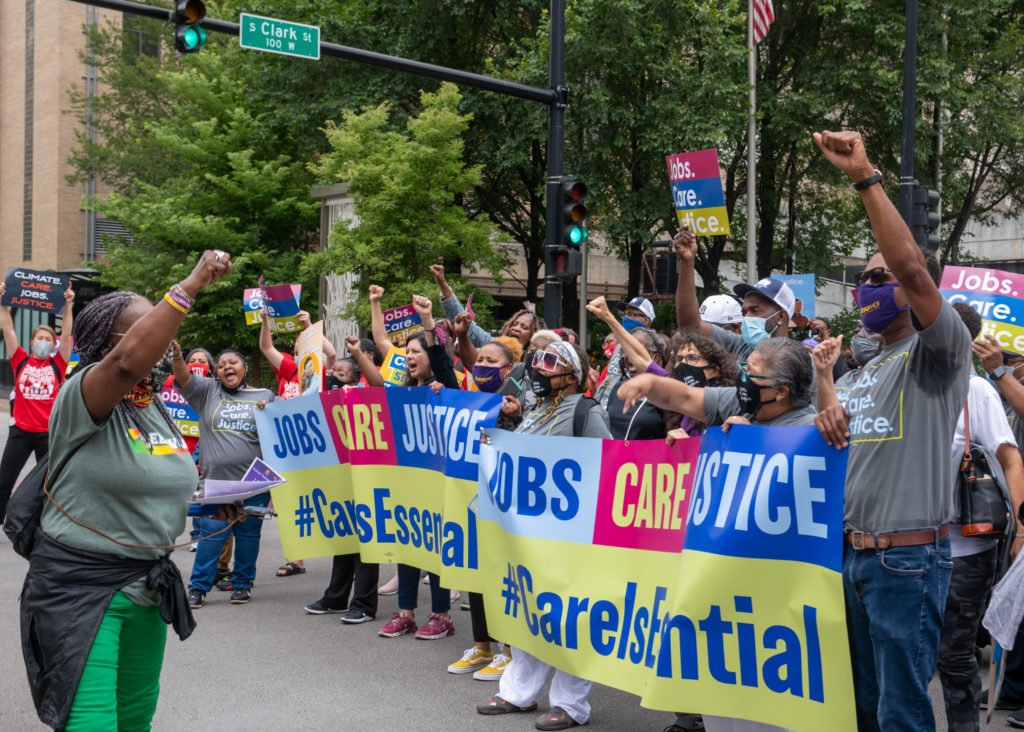
Traffic outside of Chicago’s Federal Plaza ground to a halt on November 7th as SEIU Healthcare Illinois and Indiana members, seniors, community, labor, and religious allies, and more gathered to urge elected officials to keep Medicare, Medicaid, and Social Security fully funded.
Before nearly 50 activists were peacefully arrested for occupying the Jackson and Clark intersection, hundreds gathered in the Plaza itself to hear testimony from elected officials and from those who would be devastated by a federal budget that slashes safety-net funding.
Home care member Flora Johnson brought her son Kenneth, who has cerebral palsy, to the action to illustrate what these programs mean for thousands of Illinois families.
“If Congress cuts these programs, my son could lose his wheelchair because if it breaks, I can’t afford to fix it. He wouldn’t be able to get his flu shots and asthma medication,” Flora said, addressing the crowd. “I’ve worked all my life and contributed to society, and like millions of others, I’m telling Congress to save Medicaid and make the wealthy pay their fair share!”
Rose Crawford, a Chicago PA, took arrest to help send the message that cutting Medicaid and other programs is bad for everyone–those who need care, those who work to provide it, and the economy as a whole.
“My client is a 59-year-old man with degenerative arthritis and COPD. He can’t stand up to make food for himself and clean his house, but he can live in his home with dignity if he has a little help. If Congress cuts these programs, he’ll be institutionalized in a nursing home that costs the state more than home care does, and I’ll be out of work and in the unemployment line. That’s why we’re out here, taking the streets and getting arrested–these programs matter.”
Visit our photostream to see more pictures of this event.